
Connects to where your context already lives

The cost of bad decisions
Managers spend 37% of their time deciding. More than half is wasted.
Annual loss
$250M lost at Fortune 500s to decision inefficiency alone.
Meeting creep
23 hours per week in meetings. It was 10 in the 1960s.
Wasted time
71% of senior managers say those meetings are unproductive.
The real problem
Good questions surface too late. Objections appear after resources are committed.

We're evaluating a $200M expansion of gas processing capacity at Umm Shaif. Pull in the reservoir production forecasts from SharePoint, check what Ahmad's team posted about steel procurement costs in Slack, and review the joint venture terms uploaded to Google Drive.
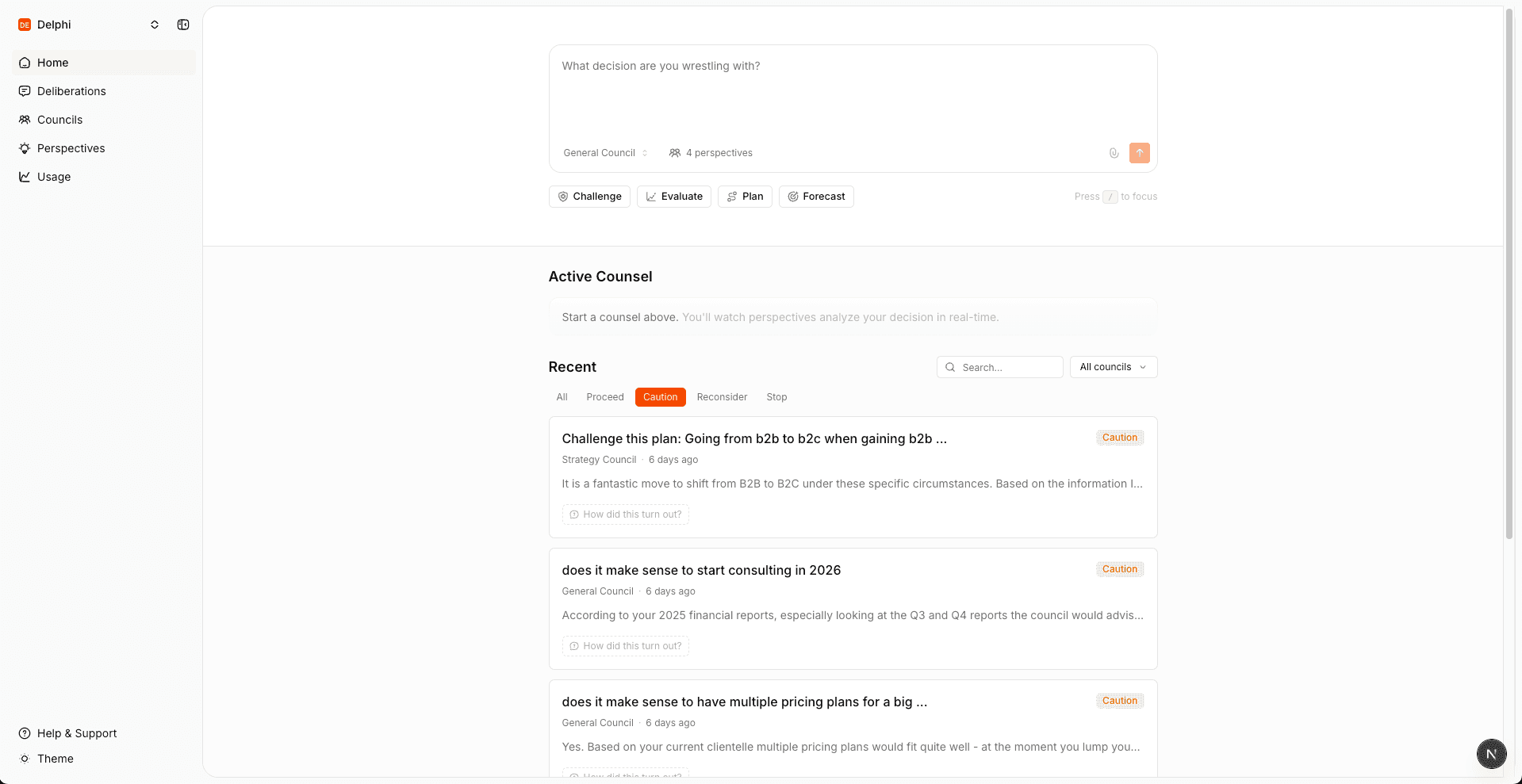
Describe the decision you're facing
Tell Delphi what you're thinking about. An investment you're considering, a hire you're unsure of, a market you might enter. Plain language, the way you'd explain it to a colleague.
Multiple perspectives analyze it simultaneously
Different models take different positions. One builds the strongest case for moving forward. Another tries to poke holes in it. Another traces out what happens next if you succeed. They work independently and don't see each other's reasoning.


See where they agree and where they don't
Delphi surfaces the points of tension, the assumptions you might be making without realizing, and where the case holds up or falls apart. You see the full picture before you commit.
Get output that fits how you work
Delphi generates summaries or full deliberations depending on who's reading, and everything exports to PDF when it needs to land in a board pack or committee deck. You can configure it around your industry, your risk tolerance, and the way decisions actually move through your organization.

Your data stays yours
We handle sensitive information. We built Delphi knowing that.
Questions
Common questions about how Delphi works.
When you ask a single model to play devil's advocate, it's still one model pretending to disagree with itself. The reasoning comes from the same place, so it tends to pull its punches or miss blind spots it was always going to miss. Delphi runs genuinely different models in parallel, each with different training and different reasoning patterns. They don't see each other's work. The disagreements are real, not performed.
Your data stays in-region and never trains any models. Each organization's data is isolated, and enterprise clients get dedicated environments. We can provide details on our security architecture during onboarding, and we're happy to work through your legal and compliance review.
High-stakes, hard-to-reverse ones. Investments, major hires, market entry, acquisitions, strategic pivots. The kind where you'd normally run a structured deliberation anyway, but the good objections take weeks to surface through meetings and memos. Delphi gets you to the real debate faster.
Yes, actually. If multiple independent perspectives all reach the same conclusion through different reasoning, that's a stronger signal than one model being confident. Delphi shows you not just what they concluded but how they got there, so you can see whether the agreement is meaningful or shallow.
A few minutes for most decisions. The models run in parallel, not sequentially, so adding perspectives doesn't multiply the wait time. Complex decisions with lots of source material might take longer, but you're not waiting days.
Yes. The default roles work for general business decisions, but you can configure Delphi around your industry, your risk tolerance, and how decisions move through your organization. If you need a regulatory lens or a specific market perspective, we can set that up.
Try it with a real decision.
Bring a decision you're actually weighing right now.
We'll show you what surfaces.